
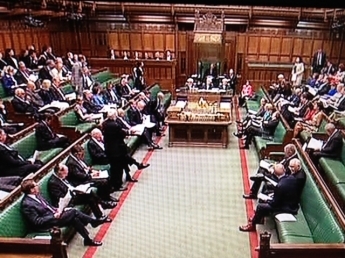
At Foreign Office Questions in January, the Foreign Secretary, William Hague failed to outline any measures the Coalition would take to save the two state solution even though he stated it was “slipping away”.
In a derelict of duty to international law and the Colaition's own own policy on the two state solution, Hague said it required the US to take the lead on the peace process. This failure to act to uphold international law and human rights and curtail settlement building simply gives Israel the green light to continue its violations.
As you can read in the questions and responses below ,the Coalition is all for showing concern and condemning Israel’s behaviour but not for taking any steps to save the two state solution and secure any progress towards peace.
Mr Andrew Love (Edmonton) (Lab/Co-op): What recent reports he has received on the political situation in the Occupied Palestinian Territories?
The Secretary of State for Foreign and Commonwealth Affairs (Mr William Hague): We continue to monitor the protests in the west bank as well as reconciliation efforts between Fatah and Hamas. We are particularly concerned about the impact on the Palestinian Authority of Israel’s withholding of revenues. We call on Israel to release those revenues in accordance with its obligations under the Paris protocol.
Mr Love: Last month, the Foreign Secretary told the House that he would discuss the diplomatic options with his European Union partners if recent settlement activity was not reversed. Given the likely outcome of the Israeli general election, that looks more distant now than ever. He recently said that he would discuss the “incentives and disincentives for both sides to return to negotiations.” What discussions has he had with his EU partners about those?
Mr Hague: We have many such discussions. As the hon. Gentleman will recall, I made my remarks in the context of the support we can give for what I hope will be a major effort by the United States on the middle east peace process—the greatest effort since the Oslo peace accords, as I have put it. Of course that awaits the outcome of the Israeli elections and the transition of personnel in the re-elected Obama Administration. I will be discussing this with the United States in Washington next week.
Robert Halfon (Harlow) (Con): Does my right hon. Friend agree that a significant barrier to peace between Israel and the Palestinians is the continued supply of weapons and funding to Hamas in Gaza? What action are the Government taking to try to stop that funding and weapons supply?
Mr Hague: Yes, my hon. Friend is absolutely right. The behaviour of Hamas and the continued supply of weaponry to Hamas are a major problem in bringing about a two-state solution and peace in the middle east. We call on all states through which such weapons might pass to interdict such weapons and prevent their passage.
Anas Sarwar (Glasgow Central) (Lab): If, as the Foreign Secretary has said, 2013 is to be the year of peace for Palestinians and Israelis, we urgently need both sides to begin meaningful peace talks. On his recent visit to the UK, did the secretary-general of the Arab League give any indication that its members would host urgent peace talks?
Mr Hague: I discussed that with Nabil al-Arabi, the secretary-general of the Arab League, when he was here two weeks ago. The Arab League, like us, looks to the United States to launch a major initiative and looks to be able to give its support to it in the same way that we in the European Union will be able to contribute, as I have said before, and as has been quoted, with “incentives and disincentives”. When the Israeli elections are completed and a new Israeli Government have taken office, it is important that that Israeli Government should be ready to enter such negotiations. It is also important that Palestinians should be ready to do so without preconditions and that the United States should be ready to launch a major new initiative.
Sir Menzies Campbell (North East Fife) (LD): My right hon. Friend will recall that it has been the policy of successive British Governments for decades that there should be a two-state solution based on the 1967 borders. In the light of the political situation in Israel and the potential situation after the election, will he give the House his objective assessment of the possibility of ever achieving a solution based on two states and the 1967 boundaries?
Mr Hague: My right hon. and learned Friend accurately describes the position of successive Governments. I have said before in this House that changing facts on the ground, principally the construction of settlements on occupied land, mean that the two-state solution is slipping away. The chances of bringing it about are not yet at an end, but it is very urgent. I do not want to speculate, of course, about the outcome of the election taking place at the moment in Israel, but I hope that whatever Israeli Government emerge will recognise that we are approaching the last chance of bringing about such a solution.
Mr Douglas Alexander (Paisley and Renfrewshire South) (Lab): Let me pick up where the last question left off. In a speech to the House in November, the Foreign Secretary said:
“If progress on negotiations is not made next year, the two-state solution could become impossible to achieve.”
Today, he talked again of the greatest efforts since Oslo. In the light of today’s Israeli elections and yesterday’s US presidential inauguration, can he offer the House a little more detail on the substance of the major American initiative of which he has spoken? What other initiatives will be possible in the course of 2013 if we are not to see the end of the two-state solution, as he puts it?
Mr Hague: The short answer on the details of the initiative is no, because it requires the United States to take the lead. That is not because other countries like us are not willing to play our own active part, but because the United States is in a unique position in the world to help bring Israel into a two-state solution. I will be going to Washington next week and discussing the question with the United States. The Secretary of State has changed and there have been many other changes of personnel in the US Administration, and I have put it to them that this should be the single highest priority for new momentum in American foreign policy, even with all the other challenges we face in the world today.
Mr Crispin Blunt (Reigate) (Con): For five and a half years now, the Quartet has followed a largely economic policy in the west bank, personified by the work of Tony Blair, presumably to try to help lay better conditions for a political settlement. That strategy has comprehensively failed as the possibility of a political settlement is much further away now than it was then. Is it not now time for the Quartet to focus heavily on the politics rather than the economics?
Mr Hague: It is very important that the Quartet does everything that it can to recognise the urgency of what we are speaking about on both sides of the House. At the same time it is very important that we do everything we can to support a Palestinian economy that is in a serious condition. As my hon. Friend knows, we provide £30 million a year in budget support to the Palestinian Authority, and the Department for International Development has provided £349 million in support of Palestinian development in the current four-year spending programme. However, the conditions are difficult, and other nations need to do more. It is important that the Israelis release the revenues that are owed to the Palestinians.
Settlement Building (West Bank)
Gregg McClymont (Cumbernauld, Kilsyth and Kirkintilloch East) (Lab): What recent representations his Department has made to persuade the Israeli Government to cease settlement expansion in the west bank.[138339]
The Secretary of State for Foreign and Commonwealth Affairs (Mr William Hague): I condemn recent Israeli decisions to expand settlements. I speak regularly to Israeli leaders, stressing our profound concern that Israel’s settlement policy is losing it the support of the international community and will make a two-state solution impossible. We will continue to press the next Israeli Government to cease settlement building.
Gregg McClymont: The Secretary of State will be aware that the political process is critical if the peace process is to begin again. I know that the UK Government decided to abstain from the vote on whether to grant Palestine non-member observer status at the UN, but does he believe that the success of the vote was a positive or negative step on the road to a peaceful solution to the conflict?
Mr Hague: Following that vote, there have of course been additional complications, including Israeli announcements on unfreezing settlement applications in the E1 area and the withholding of revenues for the Palestinian Authority, to which I referred a few minutes ago. That has meant Israel taking a step back, and that was one of the things we feared about going to the United Nations General Assembly in November. Nevertheless, it has happened. It is important for both sides to make progress. That will be our message to the next Israeli Government, and it continues to be our message to the Palestinians; both sides should be prepared to enter into negotiations without preconditions.
Bob Blackman (Harrow East) (Con): Clearly the election taking place today will have a significant effect on what happens to the next Israeli Government. What will my right hon. Friend do about the settlement activity to ensure that there is a just and peaceful solution to this long-standing problem?
Mr Hague: This raises our whole approach to the middle east peace process. As other right hon. and hon. Members have quoted in the past half hour, I attach enormous importance to this in the year 2013, particularly as there will be a new or re-elected Israeli Government, and with the US Administration beginning its second term. If we do not make progress in the coming year, people will increasingly conclude that a two-state solution has become impossible.
Sir Gerald Kaufman (Manchester, Gorton) (Lab): Is the right hon. Gentleman aware that last week Israeli soldiers murdered four innocent Palestinians on the west bank, including a 17-year-old boy? Taking that into account, along with the fact that Netanyahu said this week that, if re-elected, he will not negotiate on the 1967 borders, what specific action will the Government take to get the Israelis to see that their future survival depends on a two-state solution?
Mr Hague: We will of course continue to put that case very strongly. It is very much in the long-term strategic interests of Israel and peace in the whole region to embrace a two-state solution, because all the alternatives will be more problematic, particularly for the Israelis. I think that many people in Israel strongly hold that view—clearly, views in Israel are divided—and it is certainly our view and that of almost all other nations of the world. The role of the United States will be crucial, which is why that will be top of my agenda when I visit Washington next week.
Duncan Hames (Chippenham) (LD): I draw attention to my entry in the register. Last month I and hon. Members from both sides of the House saw for ourselves measures to segregate Israeli settlements around east Jerusalem and the E1 area, which is bigger still, from the rest of the west bank. What does the Foreign Secretary think would be the consequences for the prospects for peace talks were the Israeli Government to proceed with extending the security barrier around the E1 area?
Mr Hague: Such extensions, and any prospect of building in the E1 area, would of course be extremely damaging to the prospect for a successful peace process. That is why it is so urgent. Now that the planning process for the E1 area has been unfrozen, a clock is ticking, with potentially disastrous consequences for the peace process.
Ian Lucas (Wrexham) (Lab): The Israeli Government’s response to Britain’s abstention at the UN was, in the words of the Foreign Secretary, “taking a step back”. Therefore, will he please discuss urgently with our European partners the co-ordinated response to the present situation on the ground and use the wish for Israeli to develop stronger trading relations with the European Union as a means of achieving progress in the middle east?
Mr Hague: To be clear, the Israeli response is to the passing of the Palestinian resolution, not to the UK abstention; the hon. Gentleman may have misunderstood the motivation behind Israel’s policy, which clearly relates to the passing of the resolution.
As to the implications for future relations with the EU, provided that there is a major initiative on the peace process, in particular from Washington, we will all have to work out the incentives and disincentives that we can create to support that. But of course that is work to be done over the coming weeks and months.
