
November 2009
Gaza had already been suffering from years of economic blockade and a terrible humanitarian crisis long before the fighting started. But the situation has been ten times worse since the Israeli assault which devastated large areas of the Gaza strip and left 1,400 dead. And, although few have died since the cease-fire, the suffering is still continuing.
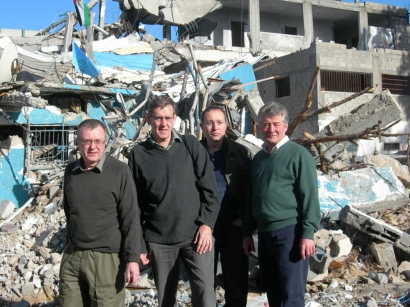
I went to see for myself with an all-party group of MPs in February, four weeks after the end of hostilities. I stood on the mounds of rubble that had once been the village of Isbet Abd Rabo and heard how Israeli soldiers had come with loudspeakers, giving people fifteen minutes to leave their homes, and then come with explosive charges, systematically demolishing each house. The 5,000 villagers were now all living in tents provided by the United Nations, apart from the 200 who died.
I saw the industrial estate that had been destroyed in the last few hours of the fighting not by aircraft and tanks but by dynamite placed in the buildings to make sure they could not be rebuilt and by bulldozers to finish off any machinery or generators. I spoke to a Palestinian businessman who had seen his ice-cream factory completely gutted even though it had no military value and had never been used by militants.
All the impressions that we formed during that visit – that the Israelis didn’t care how many civilians they killed, had a contemptuous attitude to Palestinians and wanted to destroy Gaza’s infrastructure – have all been strengthened by evidence that was come out from other sources, such as the United Nations, the Red Cross and Israeli soldiers themselves.
The UN has already completed a report on the Israeli attack on the UN compound in Gaza. The Red Cross is investigating attacks on hospitals and ambulances. And a transcript from a debriefing session at a military college makes it clear that many civilians were killed because Israeli soldiers were so keen to avoid risk and so careless of Palestinian lives that they cleared houses by shooting without warning.
A squadron leader who argued with his commander against these terms of engagement said he was saddened by “how much the IDF has fallen in the realm of ethics.” But these terms of engagement clearly had the enthusiastic support of the troops as well as the commanders. As a platoon commander said: “From what I understood from most of my men ….the lives of Palestinians…is something very, very less important than the lives of our soldiers.”
It is simply not enough to hope, as the UK Government currently does, that the full truth will emerge from the inquiry promised by the Israeli Defence Force. What we need is an investigation mandated by the UN Security Council which would be able to enforce cooperation or at least impose sanctions for non-cooperation.
None of this is to deny the right of Israel to retaliation against aggression. I have been to Sderot and to Ashqelon and I know the inhabitants of these two towns live in fear of being hit by home-made rockets. But in exercising their right to retaliation Israelis must accept two inevitable concomitants. Firstly, they must allow others to judge their conduct of war. Is it proportionate? Is it legal? And, secondly, if they attack non-combatants, they must expect them to claim the same right of retaliation.
It’s quite clear that the Israeli use of force was disproportionate. It is almost certain that the Israelis used white phosphorous and other weapons in an illegal way. We must wait for a legal verdict on the various allegations of war crimes. But already the question needs to be answered: what do we do if the Israeli attack on Gaza is found to be in breach of international law?
This is a question we already face in the West Bank. It is against the Geneva Convention for an occupying power to settle its own citizens in occupied territory. It is even more unquestionably illegal and provocative to expand those settlements. Israeli has 149 settlements in the West Bank and is still expanding them. It is also illegal to annex occupied territory as the Israelis are doing in East Jerusalem or to evict people on ethnic grounds, as the Israelis are currently doing in the Sheikh Jarra and Silwan districts of Jerusalem.
But how do we stop them? I would like to believe that we can persuade the Israeli government that what they are doing is (a) immoral and inhumane, or (b) against their own self-interest because it will create so much hatred that they will never be able to live in peace with their neighbours. But British diplomats have been protesting along these lines for quarter of a century and the Israelis have ignored them. The diplomatic channel is dead. The only way to influence Israeli behaviour is by some kind of sanction that will impact economically.
John Ging, the highly-respected head of the United Nations Relief and Works Agency in Gaza, has a simple solution to this problem: it’s called symmetry of approach. The UK must treat all countries in accordance with the rule of law. The Geneva Convention does not only oblige warring parties. It obliges contracting parties to enforce it. UK is a “high contracting party” – a guarantor – of the Geneva Convention, but there hasn’t been a meeting of the high contracting parties since in 2002.
He says we have not just an altruistic, but a legal responsibility to act. If Israel does not abide by the Convention, it is our duty to impose sanctions. He doesn’t say how this should be done – by downgrading or suspending the EU-Israeli Trade Agreement, by banning the import of settlement produce, by an arms embargo or by other measures.
The important point is that there must be a consequence for Israelis. Of course pressure can be counter-productive, as the Israelis have often found in dealing with the Palestinians. Rightly or wrongly, Israel believes itself to be under existential threat and is far more concerned about an Iranian bomb than a third intifada and if pressure is applied in the wrong way, there is always a risk they will dig themselves in deeper.
But all of these issues are interconnected and international law points us in the right direction on all of them. In the long run the interests of Israelis and Palestinians lie in the same direction – an independent, secure and viable state of Palestine alongside Israel – and the job for diplomats is to use the pressure of the international community and of international law to bring the new Israeli government to the negotiating table.
Martin Linton is MP for Battersea and chair of Labour Friends of Palestine & the Middle East.
